AERIS: Argonne's Earth Systems Model
Sam Foreman 2025-10-08
- 🌎 AERIS
- High-Level Overview of AERIS
- Contributions
- Model Overview
- Windowed Self-Attention
- Model Architecture: Details
- Issues with the Deterministic Approach
- Transitioning to a Probabilistic Model
- Sequence-Window-Pipeline Parallelism
SWiPe - Aurora
- AERIS: Scaling Results
- Hurricane Laura
- S2S: Subsseasonal-to-Seasonal Forecasts
- Seasonal Forecast Stability
- Next Steps
- References
- Extras
- Acknowledgements
🌎 AERIS
Sequence-Window-Pipeline Parallelism SWiPe
SWiPeis a novel parallelism strategy for Swin-based Transformers- Hybrid 3D Parallelism strategy, combining:
- Sequence parallelism (
SP) - Window parallelism (
WP) - Pipeline parallelism (
PP)
- Sequence parallelism (
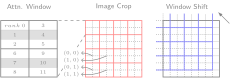
Figure 6
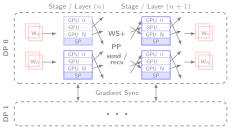
Figure 7: SWiPe Communication Patterns
Aurora
Table 3: Aurora1 Specs
| Property | Value |
|---|---|
| Racks | 166 |
| Nodes | 10,624 |
| XPUs2 | 127,488 |
| CPUs | 21,248 |
| NICs | 84,992 |
| HBM | 8 PB |
| DDR5c | 10 PB |

Figure 8: Aurora: Fact Sheet.
AERIS: Scaling Results
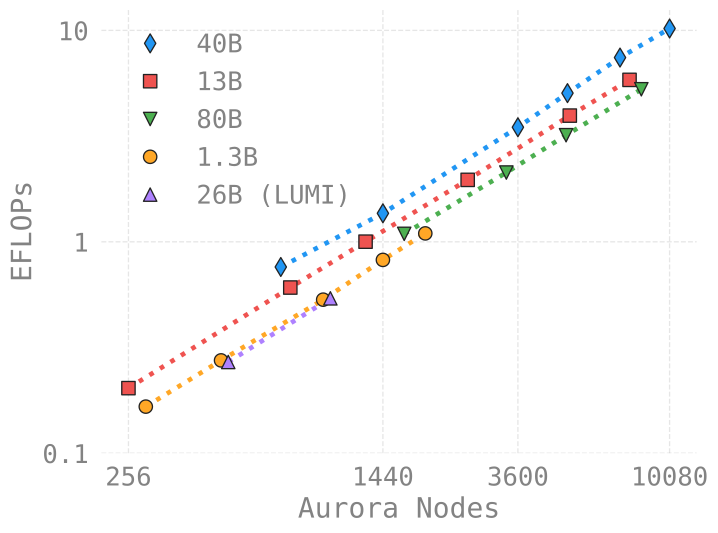
Figure 9: AERIS: Scaling Results
- 10 EFLOPs (sustained) @ 120,960 GPUs
- See (Hatanpää et al. (2025)) for additional details
- arXiv:2509.13523
Hurricane Laura
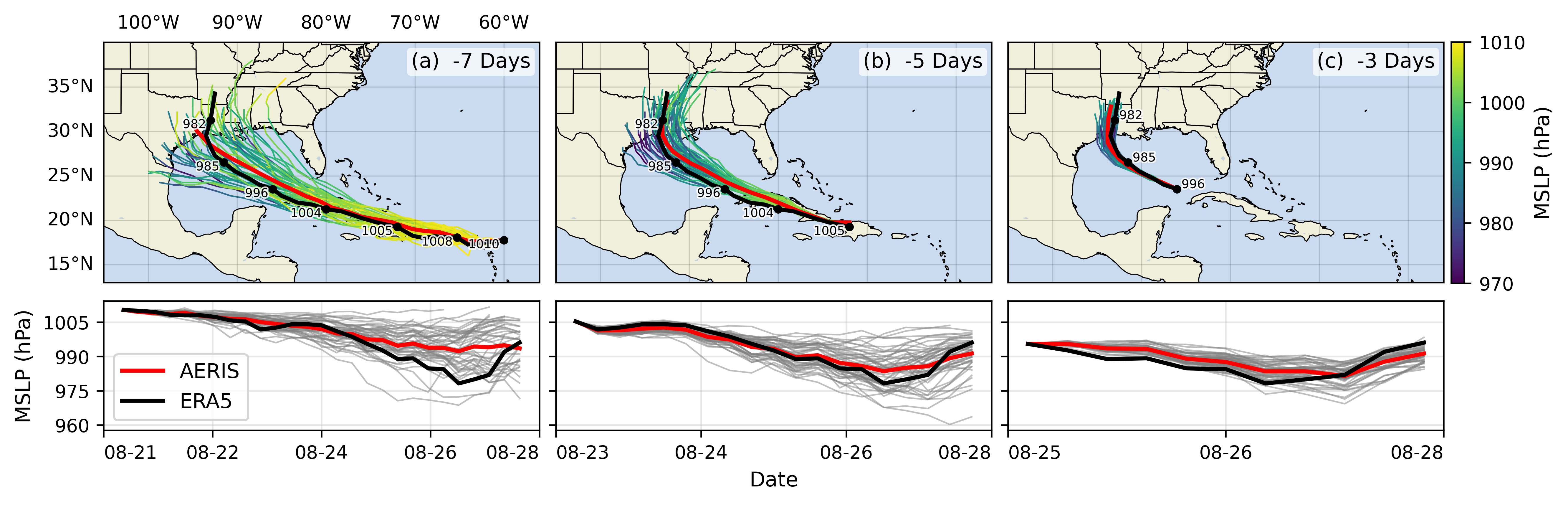
Figure 10: Hurricane Laura tracks (top) and intensity (bottom). Initialized 7(a), 5(b) and 3(c) days prior to 2020-08-28T00z.
S2S: Subsseasonal-to-Seasonal Forecasts
🌡️ S2S Forecasts
We demonstrate for the first time, the ability of a generative, high resolution (native ERA5) diffusion model to produce skillful forecasts on the S2S timescales with realistic evolutions of the Earth system (atmosphere + ocean).
- To assess trends that extend beyond that of our medium-range weather forecasts (beyond 14-days) and evaluate the stability of our model, we made 3,000 forecasts (60 initial conditions each with 50 ensembles) out to 90 days.
- AERIS was found to be stable during these 90-day forecasts
- Realistic atmospheric states
- Correct power spectra even at the smallest scales
Seasonal Forecast Stability
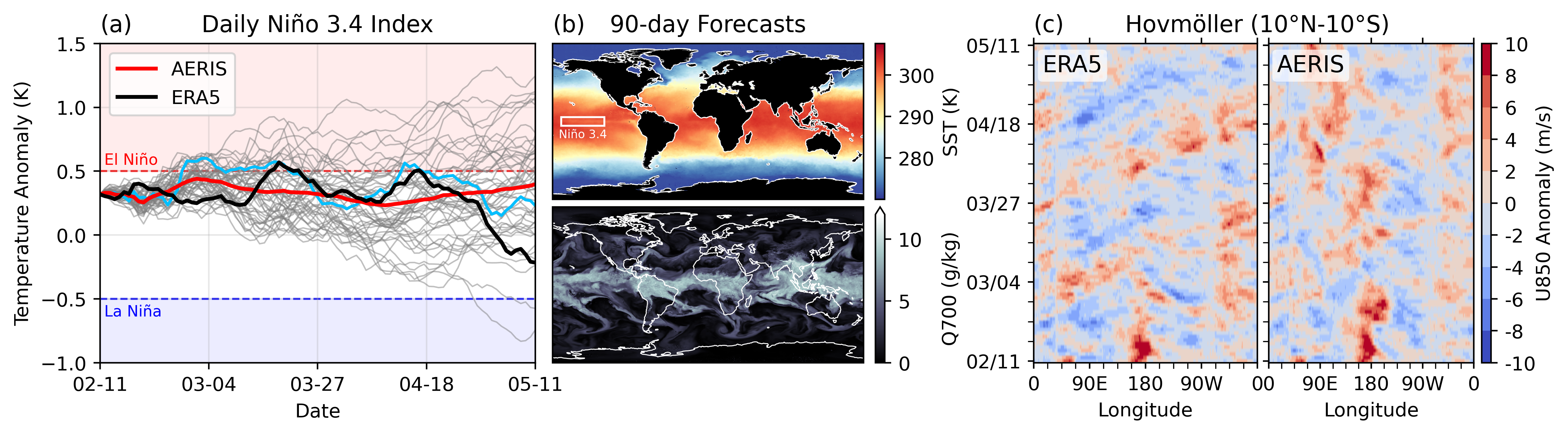
Figure 11: S2S Stability: (a) Spring barrier El Niño with realistic ensemble spread in the ocean; (b) qualitatively sharp fields of SST and Q700 predicted 90 days in the future from the
closest ensemble member to the ERA5 in (a); and (c) stable Hovmöller diagrams of U850 anomalies (climatology removed; m/s), averaged between 10°S and 10°N, for a 90-day rollout.
Next Steps
- Swift: Swift, a single-step consistency model that, for the first time, enables autoregressive finetuning of a probability flow model with a continuous ranked probability score (CRPS) objective
References
- What are Diffusion Models? | Lil’Log
- Step by Step visual introduction to Diffusion Models. - Blog by Kemal Erdem
- Understanding Diffusion Models: A Unified Perspective
Hatanpää, Väinö, Eugene Ku, Jason Stock, et al. 2025. AERIS: Argonne Earth Systems Model for Reliable and Skillful Predictions. https://arxiv.org/abs/2509.13523.
Price, Ilan, Alvaro Sanchez-Gonzalez, Ferran Alet, et al. 2024. GenCast: Diffusion-Based Ensemble Forecasting for Medium-Range Weather. https://arxiv.org/abs/2312.15796.
Extras
Overview of Diffusion Models
Goal: We would like to (efficiently) draw samples from a (potentially unknown) target distribution .
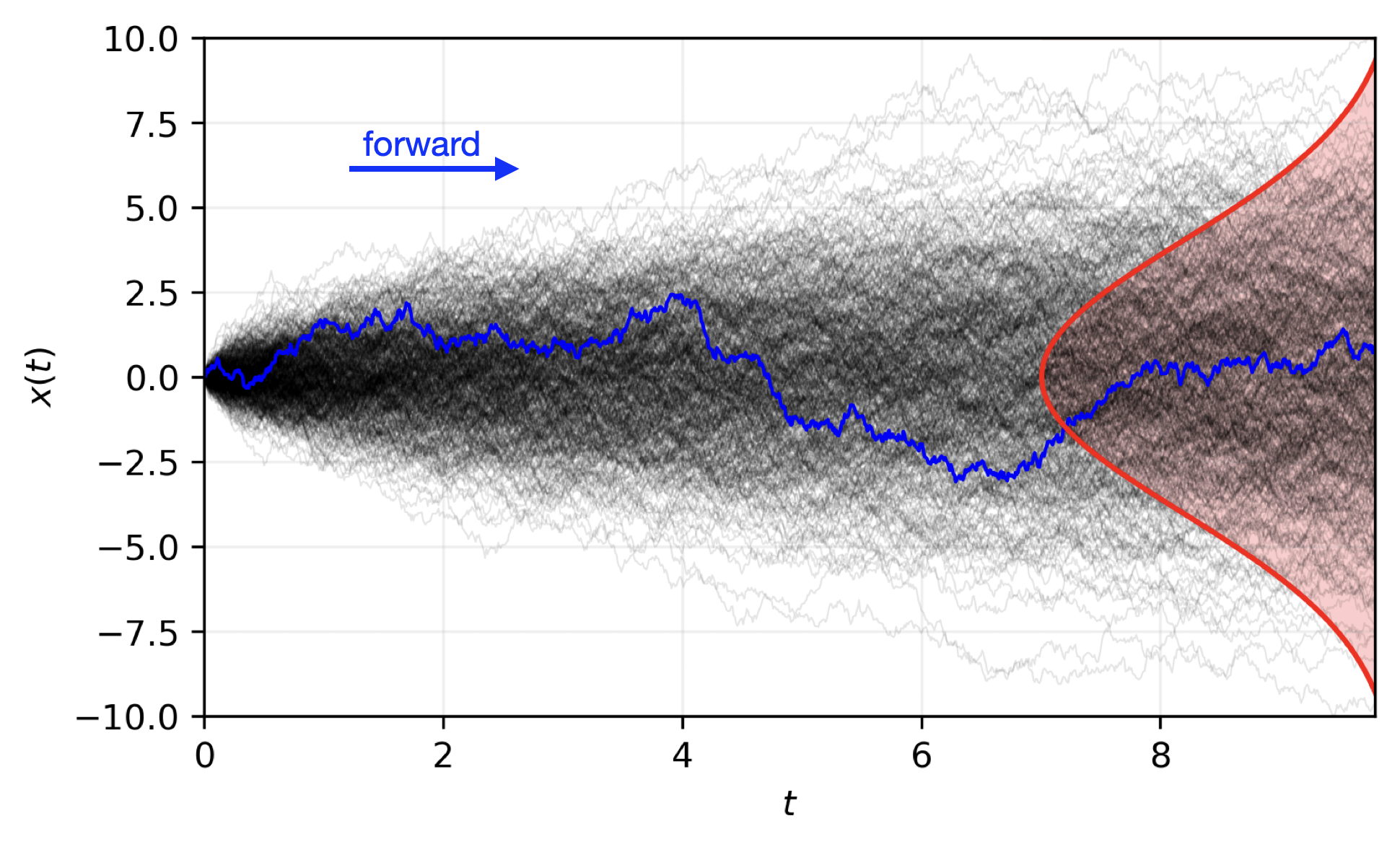
- Given , we can construct a forward diffusion
process by gradually adding noise to over steps:
.
-
Step sizes controlled by a variance schedule , with:
-
Diffusion Model: Forward Process
-
Introduce:
We can write the forward process as:
-
We see that the mean
Acknowledgements
This research used resources of the Argonne Leadership Computing Facility at Argonne National Laboratory, which is supported by the Office of Science of the U.S. Department of Energy, Office of Science, under contract number DE-AC02-06CH11357.
Footnotes
-
Each node has 6 Intel Data Center GPU Max 1550 (code-named “Ponte Vecchio”) tiles, with 2 XPUs per tile. ↩