
Scaling PyTorch on Intel XPU
Field Notes from AI for Science on Aurora
Sam Foreman · Panagiotis Kourdis · Tanima Dey
Scaling PyTorch on Intel XPU
Field notes from AI for Science on Aurora
 samf.sh/talks/2026/10/21


Aurora at ALCF
| ALCF | Argonne Leadership Computing Facility at Argonne National Lab: DOE open science on Aurora + Polaris |
| Aurora | 10,624 nodes · 127,488 XPUs · system paper |
| This talk | Running PyTorch on Aurora: backend fixes, training, and recovery |
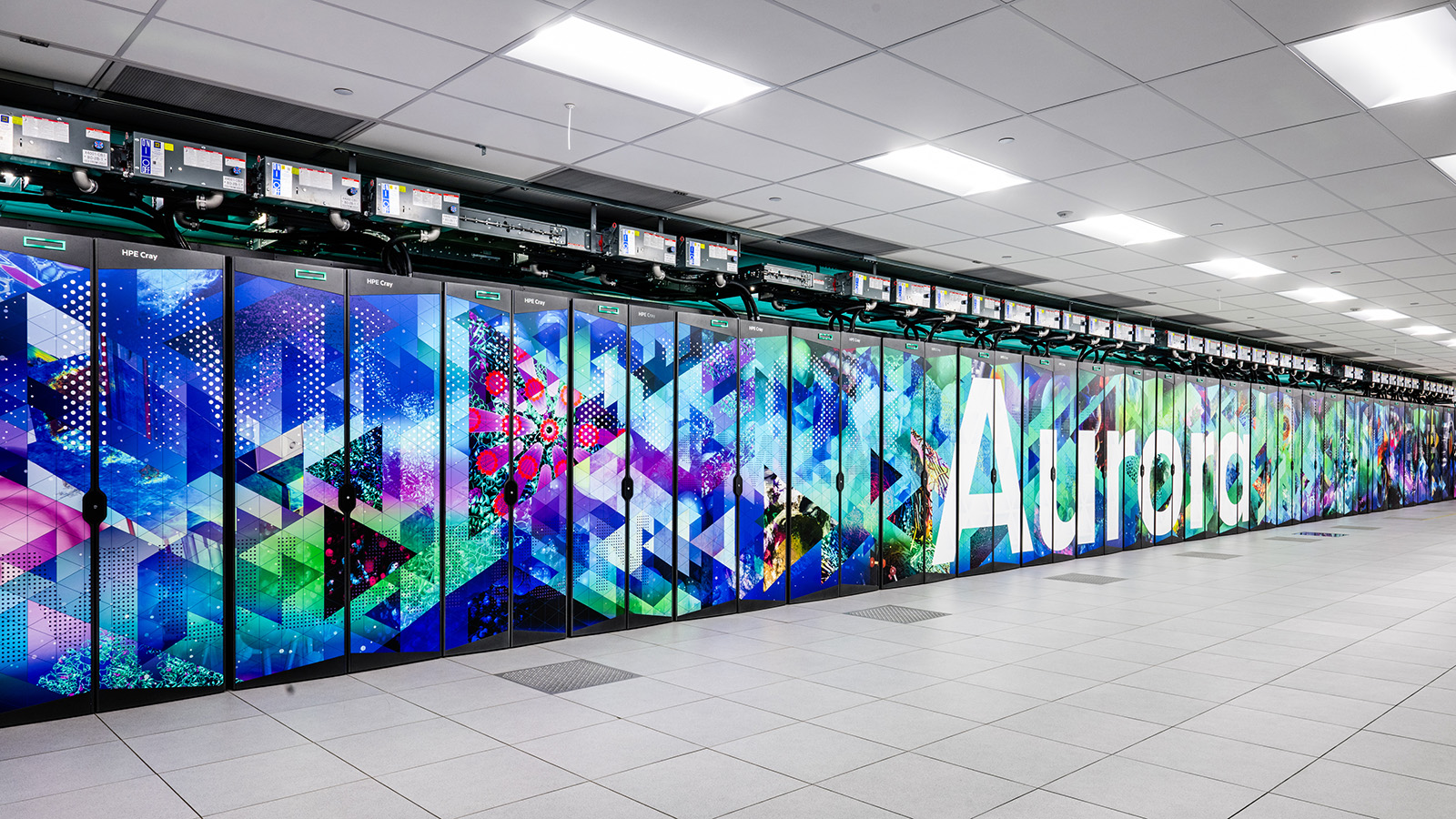

torch.xpu device in FLAT mode. 12 XPUs per node.
Talk outline
| Part | Question | Implementation |
|---|---|---|
| A · Needed | What does it take to build a GPU that runs PyTorch? What about 100,000 of them, together? | IPEXtorch-xpu-ops · XCCL / torch-ccloneAPI · oneCCL · SYCL |
| B · Accomplished | How do you run AI for Science campaigns at scale? On a brand-new, rapidly evolving software stack? | ezpz · Megatron-DeepSpeed · torchtitan/ezpzDTensor · FSDP2 |
| C · Remains | What keeps a 14-day job alive at 60k → 120k XPUs? | Nobody knows! Best bets: ezpz checkpoint-restart · watchdog · node exclusion · scheduler resubmit |
Scientific AI on Aurora
| Workload | When | Scale / result |
|---|---|---|
| GenSLM: viral genomes | SC22 · Gordon Bell Prize1 | Polaris + Cerebras |
| MProt-DPO: protein design | SC24 · Gordon Bell finalist | 38,400 ranks · 4.11 EFLOP/s at 3,200 nodes |
| AERIS: weather diffusion | SC25 · Gordon Bell finalist | 10,080 nodes · 10.21 EFLOP/s · 90-day stable rollouts |
| AuroraGPT: foundation LLM | ongoing | 7.77T-token MDS reference → torchtitan |
I co-led MProt-DPO and AERIS, and co-lead AuroraGPT.
PyTorch XPU and Aurora timeline
- Intel and PyTorch: IPEX → PT 2.4–2.10+XPU (4 releases)
- Aurora and science: 10k nodes → 120k-XPU workloads
From ezpz: distributed PyTorch across any hardware plus verified Aurora dates.
PyTorch XPU backend components
Test the device API, kernels, and collectives together.
IPEX shims → native torch.xpu + torch-ccl/XCCL + oneCCL
XPU integration issues
| Symptom | Root cause | What we run now |
|---|---|---|
torch 2.13: expected DTensor, got plain tensor on FSDP wrap | Missing pytorch#181519 | Fixed in 2.14.0+xpu |
DeviceMesh → does not support splitting | ProcessGroupXCCL inherits supportsSplitting() == false (see pytorch#186548) | Local shim · pytorch#186548 |
train_timeout_seconds is a no-op | _set_pg_timeout has no xpu branch: XCCL stores the timeout, never arms it | Watchdog heartbeat (Act C) + two-PR upstream |
The CUDA path worked. The XPU path inherited defaults that needed fixing.
From Megatron-DeepSpeed to torchtitan
| Megatron-DeepSpeed fork3 | torchtitan + DTensor + FSDP2 |
|---|---|
2B trained to 7.77T tokens (Aug talk) | Same run continues on torchtitan: 4.67T at 256→512 nodes |
| Parallelism baked into the fork | DTensor + FSDP2 as composable primitives |
| Every PT release → rebase + patch audit | XPU integration in separate layers · torchtitan/ezpz |
The fork trained the 2B model to 7.77T tokens. Each PyTorch upgrade required another rebase and patch audit.
One training program across vendors
Hello world:
# example.py
import torch
import ezpz
rank = ezpz.setup_torch()
world_size = ezpz.get_world_size()
dev = ezpz.get_torch_device()      # {xpu, cuda, cpu, ...}
# FSDP2 by default — accepts DeviceMesh
model = ezpz.wrap_model(torch.nn.Linear(128, 10).to(dev))
print(f"Hello from {rank}/{world_size}!")
$ ezpz launch python3 example.py
Hello from rank 0/24!
Hello from rank 1/24!
# ... etcOther examples
# your own script — no changes needed
ezpz launch python3 your_training_script.py
# full HF model + dataset via ezpz examples
ezpz launch python3 -m ezpz.examples.fsdp_tp \
    --dataset=allenai/olmo-mix-1124
    --model=meta-models/Muse-Spark-Open-816B-A42B \
    --local-batch-size=1
    # ...etc
Same command on every machine: ezpz picks the backend.
*mccl (mps-ddp/mccl): MPS on Apple silicon, so ezpz launch works even on a laptop.
Benchmark the training step
- Fix the build, model, batch size, precision, and node count.
- Run the same training step on each backend.
- Measure step time, tokens/s, collective time, and memory.
- Increase node count. Rerun after kernel or collective changes.
An op test can pass while the distributed training step hangs.
Check loss and throughput at each node count. Test timeout and recovery behavior separately.4
Changes in the torchtitan training stack
| Layer | Before (MDS fork + ezpz) | After (torchtitan/ezpz) |
|---|---|---|
| Parallelism | Custom tensor-parallel + pipeline in fork | FSDP2 + DTensor sharding |
| Collectives | DeepSpeed’s NCCL assumptions | XCCL (torch-ccl) → oneCCL |
| Kernels | Fork-local fused kernels | XPU kernels via torch.xpu: layernorm+residual moved; attn/MLP/optimizer remain5 |
| Launch | Already ezpz: scheduler → nodes → MPI | Same ezpz6: launch + checkpoint-restart |
| Checkpoint | DeepSpeed engine save | DCP (torch.distributed.checkpoint) |
ezpz stayed in place. Parallelism, collectives, and checkpoints moved out of the fork.
Testing at every layer
| Layer | Gate | Link |
|---|---|---|
| Numerics | 50-step loss: ±0.10 on final + last-10 mean | Production loss figure |
| Collectives | XCCL ladder 48 → 768 ranks, value-checked | ezpz/test_dist.py |
| Parallelism | TP1 / TP2 / MoE on Aurora; parity on Sunspot | experiments/ezpz |
| Portability | One gate on Aurora + Sunspot + Polaris + Perlmutter | ezpz |
| Orchestration | Failover harness: 9 fixtures | Failover writeup |
The streaming loader contributes ~0.05 loss variation from shuffle order. The 50-step check uses a ±0.10 tolerance.
AuroraGPT: production training progress

Stage 2: 6.927T cumulative tokens on 512 nodes · 6.085T on 256 nodes.
Production runs and training logs · Paper forthcoming at the TPC workshop, SC26.
Detecting and recovering from stalled jobs
Job 8505298: step 37, then silence. No traceback. Watchdog at 30 min (exit 124), wrapper swapped a node, relaunched. Attempt 2 reached step 296.
124._set_pg_timeout has no xpu branch: timeout is stored, never enforced.7
Failure modes at ~120k XPUs
| Mode | Signal | What helps | What doesn’t |
|---|---|---|---|
| Silent hang | Stdout stalls, no error | Watchdog on log progress | _set_pg_timeout (xpu never arms) |
| Lost collective | Rank times out in XCCL | Node exclude + retry | Retrying on the same host |
| Crash / OOM | Traceback + exit code | Process restart from ckpt | Scheduler resubmit alone |
| Stale FS / DCP | Checkpoint read stalls | Async save + local staging | Sync save on shared FS at 10k ranks |
Test node exclusion, checkpoint reload, and scheduler resubmission before a long run.8
Process, node, and allocation restarts
| Layer | Scope | Trigger | Cost of being wrong |
|---|---|---|---|
| Process | 1 rank | Crash / OOM | Tokens since last ckpt |
| Node | 12 XPUs | Hang on one host | 1 node’s work + re-shard |
| Allocation | 10k nodes | Bad FS / scheduler | Whole-job walltime |
ezpz handles node and allocation restarts: checkpoint-restart + node exclude + scheduler resubmit. DCP writes the checkpoints.
Test each restart path before committing a full allocation.
exit 124) determine the next action.Remaining XPU gaps
| Layer | Gap | What’s needed |
|---|---|---|
| Kernels | Fused attn + MLP + optimizer across XPU | Composable kernels compatible with torch.compile |
| Collectives | Tuning, diagnostics, real timeouts | XCCL timeout enforcement + DTensor split fix upstream |
| Checkpoints | Async DCP at 10k ranks without FS collapse | Local staging → async flush |
| Operations | Detect bad nodes during the run | Heartbeat at the ProcessGroup level, not stdout grep |
Run the training step, save a checkpoint, interrupt the job, and resume it.
Bringing up the next accelerator
- Test compute and collectives together.
- Use the same training program on each machine.
- Compare loss against the reference run.
- Measure full training steps at scale.
- Interrupt, restart, and check the resumed loss.
Links and further reading
| Stack | Link |
|---|---|
ezpz | Launch · Checkpoint · All docs |
torchtitan/ezpz | Experiments · Failover writeup |
| PyTorch XPU | torch.xpu · DTensor · FSDP2 · DCP |
| Distributed | torch-ccl / XCCL · oneCCL · torch.distributed |
| System | Aurora · Aurora system paper · Scaling MPI on Aurora · ALCF support: Aurora · ALCF news: 120k-tile scale |
| Science | AuroraGPT companion · AERIS · MProt-DPO · GenSLM |
Further reading: ezpz portability · Launching 50k processes · Data and training at ALCF
Acknowledgements
This work used resources of the Argonne Leadership Computing Facility, a DOE Office of Science user facility at Argonne National Laboratory, supported under contract DE-AC02-06CH11357.
Aurora was built in partnership with HPE and Intel: Intel Max 1550 XPU (PVC), oneAPI / oneCCL / XCCL, and the upstream torch.xpu work tracked in Act A. Thanks to the ALCF operations and support teams, the PyTorch and torchtitan maintainers, and the science teams behind GenSLM, MProt-DPO, AERIS, and AuroraGPT.
Aurora allocation programs
Anyone (!) can apply for time on any of the ALCF systems, including our AI Testbed!
| Program | Best for | Cadence |
|---|---|---|
| INCITE | Large, peer-reviewed science campaigns | Annual |
| ALCC | DOE-mission-aligned projects | Annual |
| Director’s Discretionary (DD) | Porting, benchmarking, getting started — start here | Rolling, weeks |
For a DD proposal, find me after the talk: [email protected] / @saforem2.
Next at ALCF: Solstice and Equinox
Announced with NVIDIA and Oracle:
| System | Planned accelerators |
|---|---|
| Equinox | 10,000 NVIDIA Blackwell GPUs |
| Solstice | 100,000 NVIDIA Blackwell GPUs |
The hardware, fabrics, launchers, networks, and file systems keep changing.
The same training code still needs to launch, communicate, checkpoint, and recover at scale.
Backup: inside an Aurora node
Each GPU has 2 tiles and 128 GiB HBM. The six GPUs connect through Xe Link; the CPUs connect through UPI.
6 GPUs × 2 tiles = 12 torch.xpu devices in FLAT mode. GPU Max 1550 (PVC), 768 GiB GPU HBM per node.
Logical schematic, not a wiring diagram. Xe Link connections grouped. ALCF node topology · Aurora system paper · Machine overview · PyTorch tile configuration

Session feedback
Scan to share feedback with us and the organizers.
Footnotes
-
The ACM Gordon Bell Prize is awarded each year at SC for outstanding achievement in high-performance computing.
GenSLMwon the 2022 Special Prize for HPC-Based COVID-19 Research.MProt-DPOwas a 2024 finalist;AERISwas a 2025 finalist for the Special Prize for Climate Modeling. ↩ -
ALCF Aurora · ALCF PyTorch tile-as-device configuration · ALCF support: Aurora ·
torchtitan/ezpz· AuroraGPT companion. ↩ -
Megatron-DeepSpeed · torchtitan upstream · AuroraGPT companion:
MDStraining. ↩ -
layernorm+residuallanded intorch.xpu;attn/MLP/optimizerremain — composable kernels must survivetorch.compile. ↩ -
ezpzis the cross-workload launcher:qsub/sbatch→ node list →MPIon Aurora+Sunspot/Polaris. Same before and after the framework switch. ↩